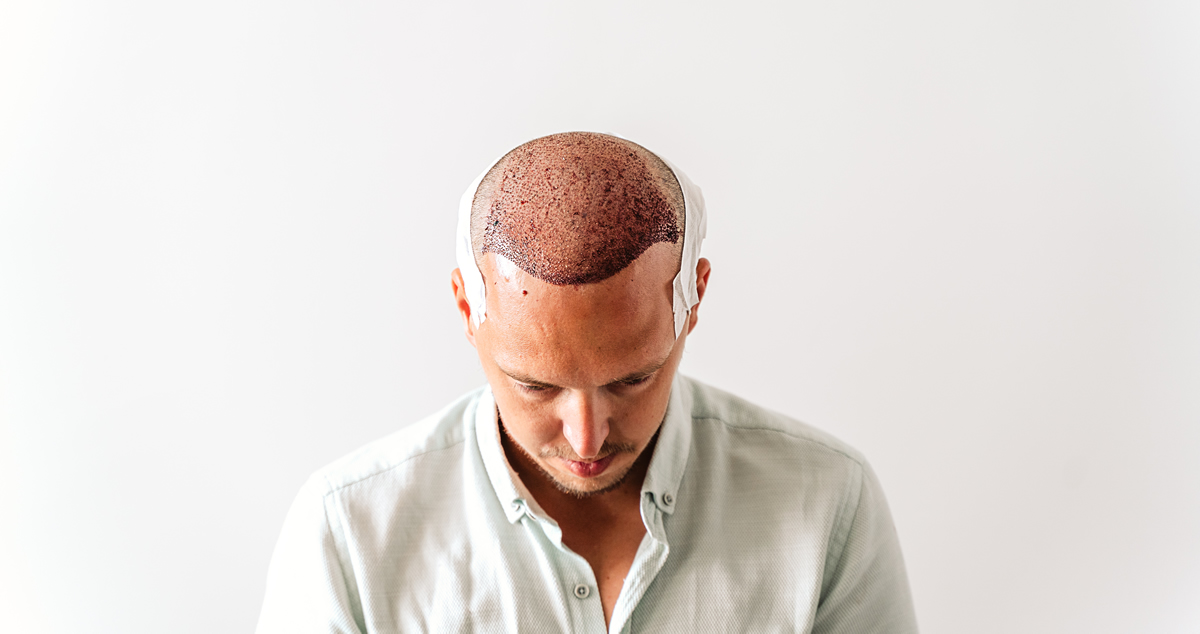
What is Hair Transplantation?
Hair transplantation is the transplantation of hair follicles to the complained areas by taking hair follicles from the donor areas with different methods for those who complain about baldness and hair thinning.
There are basically 2 methods for hair transplantation: FUT and FUE. While the oldest of these methods is the FUT method, the FUE method has started to gain more importance if this method is developed and its disadvantages are minimized.
The advantages of the FUE method are; almost no scar, as many hair follicles and hair transplant as possible.
Regardless of which hair transplantation method is used, this process consists of certain stages. Stages can be limited to pre-application, application-time and post-application.
The main stages of hair transplantation are as follows:
- Root retrieval,
- Opening the channels where the roots will be placed,
- Performing hair transplantation.
Hair follicles to be used in hair transplantation are best taken from the scalp at the back of the person's head. If this area is not suitable, roots can be taken from the back and chest, if the doctor approves.
Hair Transplant Methods
Those who have complete hair loss or sparseness problems should go to a suitable clinic with expert staff without wasting too much time. The choice of doctor and clinic here is to look at the previous studies and most importantly to contact the doctor one-on-one. In this way, you can ask what you are curious about and eliminate the question marks in your mind. Your doctor will determine the most suitable technique for you. At this stage, you should state your exact wishes and concerns to your doctor, and the most correct way should be followed accordingly.
We mentioned that there are two main methods of hair transplantation. In both methods, hair follicle transplantation is performed.
The most obvious difference between the two techniques is that in the FUE (Follicular Unit Extraction) technique, there is no scar in the area where the hair is taken from the nape of the person. In the FUT method, some scars remain after the hair follicle is removed from behind the ear.
In the second FUT operation, a part of the hairy area on the back of the person's head is cut in the form of a strip. The diameter of this strip varies according to the number of grafts needed. After the procedure, a scar remains in this area. It is divided into grafts with 1-4 roots in the form of strips and made ready for transplantation.
What is FUE Hair Transplant Method?
The back of the hair is used as the donor area. Since the hair follicles around the nape and nape are stronger than other regions, this is usually used as a donor area. However, if there is no hair in this area, it is possible to take hair follicles from other parts of the body.
It is taken one by one from the donor area with the help of 0.7-1 millimeter micromotor tools. The taken roots are planted in a sparse or completely open area. An average of 2500-3500 grafts are added to the area to be transplanted. No stitching is required in this procedure. Since it is a non-surgical method, there is no visible scar in the donor area.
There is no pain in the FUE procedure performed using local anesthesia. This process takes approximately 5 hours. It is recommended to rest for 1 day after the procedure. It is possible to go to work easily the next day. The transplanted hair starts to grow after 3 months and it takes 9 months to completely grow out.
FUE or FUT Hair Transplantation?
SITUATION |
FUE |
FUT |
Tracing |
vaguely |
strip between 2 ears |
Graft Quality |
Good |
Good |
Number of Grafts That Can Be Taken |
More |
Less |
Healing Process |
Shorter |
Longer |
Pain During the Recovery Period |
Less |
More |
shaving |
Was |
No |
Exercise restriction after October |
at a shorter level |
longer level |
Hat use |
recommended |
recommended |
The prevalence of the technique |
more common |
rare |
The number of those suitable for transplantation in the collected hair follicles |
More |
Less |
Rest period after sowing |
3-4 days |
2 week |
Number of Grafts Matters
The FUT technique, on the other hand, is a method based on the removal of grafts with a diameter of 0.9-0.5 mm, one by one, from the same area with the help of an electric micromotor. There are 1-4 roots in each of these grafts.
It is possible to apply safely in both intake methods. However, in some aspects, the FUE technique is more advantageous than the FUT application. So, what are the advantages of the FUE technique in hair transplantation?
In FUE operation, it is possible to take a smaller size graft. While these thin grafts are placed in the canals, inclination and direction can be determined easily, which helps the natural appearance.
In FUE technique; All of the hair must be shortened before starting the grafting process. In the FUT technique, thinning only the strip-shaped section to be removed is sufficient. However, due to the other advantages it provides, the FUE technique; It is the most preferred method of purchase today. However, patients who do not want this procedure on their hair can also prefer the FUT technique. The same methods can be applied for beard transplantation.
More than 50% of men over the age of 50 will be greatly affected by male pattern baldness, according to the US National Library of Medicine (NLM).
The next step after the removal of the roots is the opening of channels to the area with hair loss. For this purpose, the lateral slit method is applied to the patient. The lateral slit method is performed with specially produced inserts. These mini surgical scalpels used allow the opened channels to be in accordance with normal anatomy. These opened channels allow the grafts to be placed in their new sockets with the desired and necessary horizontal angles.
Are There Any Side Effects of Hair Transplantation?
As with every medical procedure, there may be some side effects in hair transplantation.
- Bleeding signs,
- Slight swelling,
- Risks of infection,
- Circulatory disorders,
- Bruising around the eyes,
- A light crust on the skin area where the hair was removed or implanted,
- Numbness in the transplanted areas,
- Itching.
After the number of canals suitable for the maximum number of grafts that can be taken is completed, it is now time to plant (place) the roots in their canals. After the sowing is completed, a dressing is applied to the patient's acquisition and transplantation area. The patient is discharged with a bandage. 4 days after the procedure, the bandage is opened under the control of the doctor. After a hair washing period of 5-7 days, the transplanted area regains its normal appearance.
In the first 1 or 2 months after planting, the hair shafts of the transplanted roots may fall out. From the 3rd month, the patient experiences that his new hair starts to grow. In the first 6 months following the transplantation, a large part of the hair will come out. In the second 6-month period, the remaining hair grows and the patient regains his final appearance in a period of 12-14 months.
Although the hair transplant technique is a very comfortable practice in today's conditions and the results are so satisfying, it is of vital importance that the operation is performed under the conditions of the operating room where the anesthesiologist is present, with sterile tools, and under the leadership of an experienced team and especially an aesthetic surgeon.
Our hair is not one of the first things that come to mind when it comes to beauty and attractiveness. However, in reality, whether male or female, we care about the health, shape, color and most importantly the existence of our hair. As with men, hair transplantation is also important for women. It is undeniable that our hair completes the integrity of our appearance. The number of people who experience hair loss is not small at all.
Causes of Hair Loss
- Structural hair loss,
- Hormonal,
- It can have various causes, such as hair or scalp diseases.
When hair loss and baldness are permanent, people look for ways to replace their lost hair with new ones. The person tries to overcome this deficiency with a temporary and extremely uncomfortable choice such as a wig or prosthesis, and sometimes with a medical and permanent method such as hair transplantation.
Today, when it comes to the treatment of complete or partial baldness, the only valid and permanent treatment method is hair transplantation. Hair transplantation is a procedure with a history of more than 20 years in our country and in the world. The experience gained over the years has increased and the techniques have been developed considerably on this ground.
Hair transplantation techniques have now reached a point where everyone interested in this subject is well-informed and well-informed. Where the hair is taken from, where it is transplanted, how long the transplantation process lasts, what situations are encountered in the post-transplantation period… All of these issues are now obscure for both the practitioner and the patient.
When it comes to the front line naturalness between the patient and the transplant, the maximum number of hair follicles that can be taken from the person who is examined, how large the diameter of the grafts can be, and how close the angle that can be given to these roots during planting can be to the natural, information transfer of more advanced and detailed topics. has come into question. Because the main theme in hair transplantation does not change. The hair is taken from the nape area (the area between the two ears at the back of the head) where the hair is dense and transplanted to the missing front or top area. However, today, the important issues focus on how comfortable the process after the procedure will be and how natural the result will be. Hair transplant prices may vary according to quality and expertise.
There are many factors that make the result natural. The factors that will bring naturalness are that the diameter of the grafts taken is as small as possible, the smallness of the opened channels and the narrow angle of the canal angles closest to the natural, the narrowest angle possible while planting and taking the direction of the patient's existing hair as a reference. Interpreting all these details requires experience.
The patient who comes with a hair transplant request should be evaluated very well. It is important whether there is a need, whether it can be transplanted, and if it is done, the patient's expectation and the result will show a correlation (proportional compatibility).
How to do hair transplantation?
Hair transplantation should be performed by specialist doctors and their teams under local anesthesia and sedation (the method in which the patient is relieved by creating a sleepy state in anesthesia. It is used to support local anesthesia) in operating room conditions. Ensuring operating room and sterilization conditions is of great importance.
- Grafts are taken one by one from the donor area with a micromotor sharp head.
- The smallest possible motor tips should be used for grafting. In this way, damage to the receiving area will be prevented and a natural appearance will be provided in the cultivation area.
- The number of grafts that can be taken is in line with the hair density and quality of the hair in the donor area. In addition, the fact that this hair is dark, thick and wavy also affects the result positively.
- After the graft is taken, the grafts are kept in the PRP liquid prepared from the patient's own blood using the PRP (Platelled Rich Plasma) method.
- Some of this liquid, which has the feature of supporting cell regeneration, is injected into the area to be transplanted to provide support to the hair and scalp after transplantation. Applied PRP not only accelerates wound healing, but also increases the quality of the transplanted hair and the rate of attachment to the transplanted area.
- Considering the number obtained, the correct planning is made for the balding areas. The most important point at this stage is the front line line. The front line of the scalp is the most important element that will give the image of naturalness to the transplant. While this border is being reshaped, the expectation of the person who wants to have an optional unshaven hair transplant should also be learned; however, the correct anatomical rules must be strictly adhered to. A front line drawing should be performed in accordance with the person's age, bone structure and the number of grafts obtained, and this line should be adhered to.
- The next stage is the opening of the 'channels where sowing will be carried out'. The channels are opened with a thin-tipped scalpel called the 'Lateral Slit'. The ends of these slits are specially designed and their shape feature allows channels to be opened horizontally. Opening the channels with these slits allows the hair to be planted with narrow angles close to natural. This feature is one of the elements that will make hair transplantation look natural.
PRP Hair Transplant
The grafts, which have been kept in PRP fluid for a while, are placed in these channels with great care. When the transplantation is finished, the grafted area of the patient and the transplanted area are covered with a dressing. The patient is discharged on the same day. After 4 days, the dressing is opened under the control of the doctor and the first hair wash is done. Performing the first wash by the health personnel eliminates the anxiety and the patient is properly experienced. At the end of 3-5 days of washing, which the patient will continue to apply at home, the existing small blood clots are removed from the environment. The first patient after transplantation can return to his daily life. There is no medical problem in his work. In positions that require visual appearance, the person can easily return to work after 3-5 days of rest.
Hair Transplant Results
In the first 2 months after planting, the hair shafts of the transplanted hair follicles are shed. From the 3rd month, new hair shafts begin to grow. At the end of the 6th month, 70-80% of new hairs will have grown. The remaining hair, which will complete the rate of 90-99% in total, will grow at the end of the second 6-month period. During the period when the patient's hair starts to grow, he can care for his hair with support products. The hair that has grown out naturally grows and is permanent.
At the end of the first year, it is possible to have a second hair transplant if it is deemed necessary and requested by the patient. Although not usually necessary, a second transplant may be appropriate because the number of grafts that can be obtained is limited in some patients. In selected cases, the required number of grafts can be achieved by using hair follicles taken from the chest or back of the body.
Accurate planning of the evaluation of all these stages and applying them specifically to each patient requires technical knowledge and, more importantly, experience.
Before choosing the expert staff who would like to have hair transplantation;
- the current experience of the team,
- sterilization of the medium to be planted,
- whether the operating room conditions are met,
- It should be well evaluated whether adequate information and contact support will be received during the result period, which will last for 1 year after planting. All these information are extremely important elements that will increase the satisfaction rate to be heard from the result.
Can Baldness Be Prevented or Prevented?
Baldness can have different causes; if it is caused by some material deficiencies (such as lack of vitamins, minerals, enzymatic factors, blood values). Unfortunately, since male pattern baldness is a genetic feature, there is currently no way to prevent it.