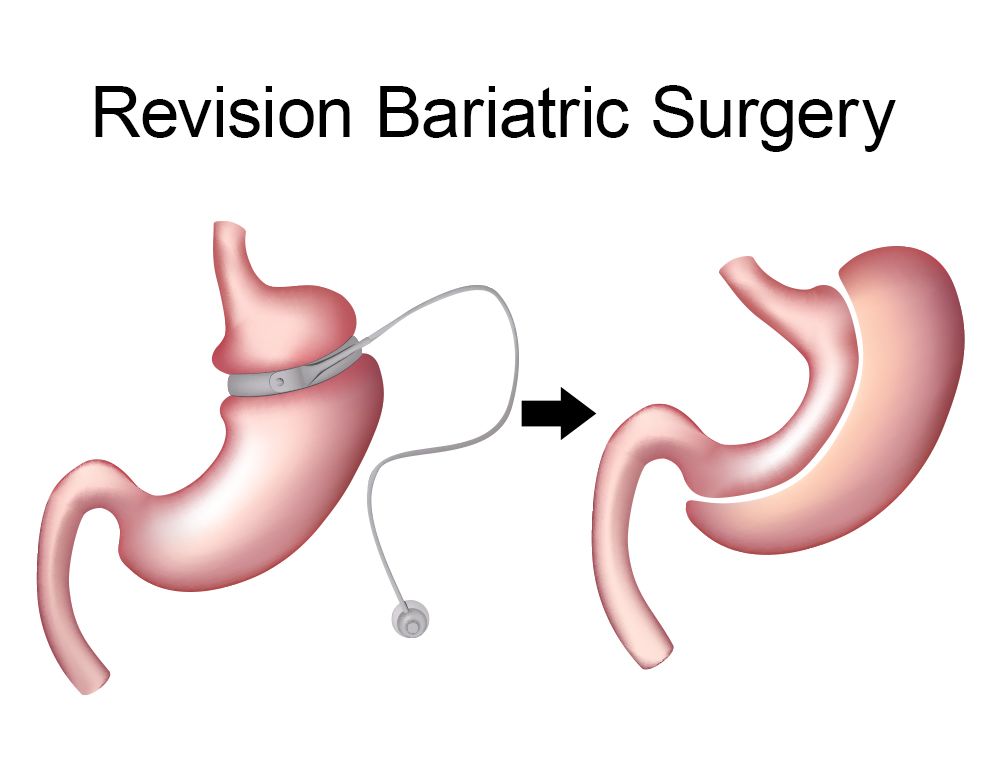
Revisional Surgery
Revisional surgery is applied if people who have undergone surgery due to obesity have lost insufficient weight, gained weight again, lost excessive weight, torsion rotation) and stenosis. It is performed after the operation where the fundus resection was not performed properly and the fundus resection was insufficient. In addition, the stomach may be left large. In this case, revisional surgery is applied.
What is Revisional Surgery?
Even if the revision surgery was performed properly, weight loss may still not have been achieved. In this case, it is used as an absorption-reducing method after gastric sleeve surgery. It is applied to patients with severe reflux complaints after sleeve gastrectomy. In addition, RNY gastric bypass can be performed as a revisional surgery method for patients who have nutritional problems due to torsion (rotation) and stenosis at the end of the stomach.
Revisional Surgery Processes
The revisional surgery process varies according to the revisional surgery area. First, it is determined whether the person is suitable for surgery again. It is discussed why the first surgery failed in suitable patients. It is determined whether the failure of the operation is due to the patient or to the operation. The psychological state of the patient is also important in this process. If stomach enlargement has been experienced after surgery, stress-related eating disorder may be present.
All these should be evaluated and operated accordingly. If these conditions are also determined, some examinations and tests are requested from the patient. Upper GIS endoscopy, passage x-ray results and blood tests, endoscopy, pulmonary function tests, anesthesia evaluation are checked. The day of surgery is decided and the patient is taken into surgery.
What are Revisional Surgery Methods?
Revisional surgery is a procedure performed instead of renewing the surgery. The person may have made the wrong choice of surgery or the operation may not have taken place as desired. In this case, revisional surgery is used. Revisional surgery methods are as follows;
- Revisional surgery after gastric band insertion,
- In revisional surgery of patients with gastric bypass, if the passage between the stomach and intestines is widened, it is re-narrowed by endoscopy,
- If the patient could not lose weight in the revisional surgery of the patients who had sleeve gastrectomy surgery, or if the stomach grew again, the procedure of repeating the sleeve gastrectomy procedure,
- Revisional surgery of duodenal switch surgery,
- Revisional surgery of patients with Transit Bipartition surgery
What are the Risks of Revisional Surgery?
The risks of revisional surgery are higher than the first gastric surgery. For an individual who has had his first bariatric surgery, the probability of bleeding or leakage is around 1-2%. However, this rate increases to 3-4% for a person who has revisional surgery of this surgery. However, with a good specialist selection, the probability of risks occurring is considerably reduced. The success rate in revision surgery is 96%. For this reason, it is important to be under constant examination and control both after obesity surgery and when revisional surgery is applied for any problem.
Revisional Surgery Recovery Process
The revisional surgery recovery process is the same as the initial surgery process. The patient stays in the hospital for 2 or 3 days after the operation. In this process, the patient is observed and controls are provided to ensure that there is no mishap. At the end of the first week after returning home, the patient should go to the doctor's control. Afterwards, this process continues for 1 month, 3 months, 6 months and once a year. When a person feels any discomfort, he should immediately consult his doctor.